繁體中文 Inquiry

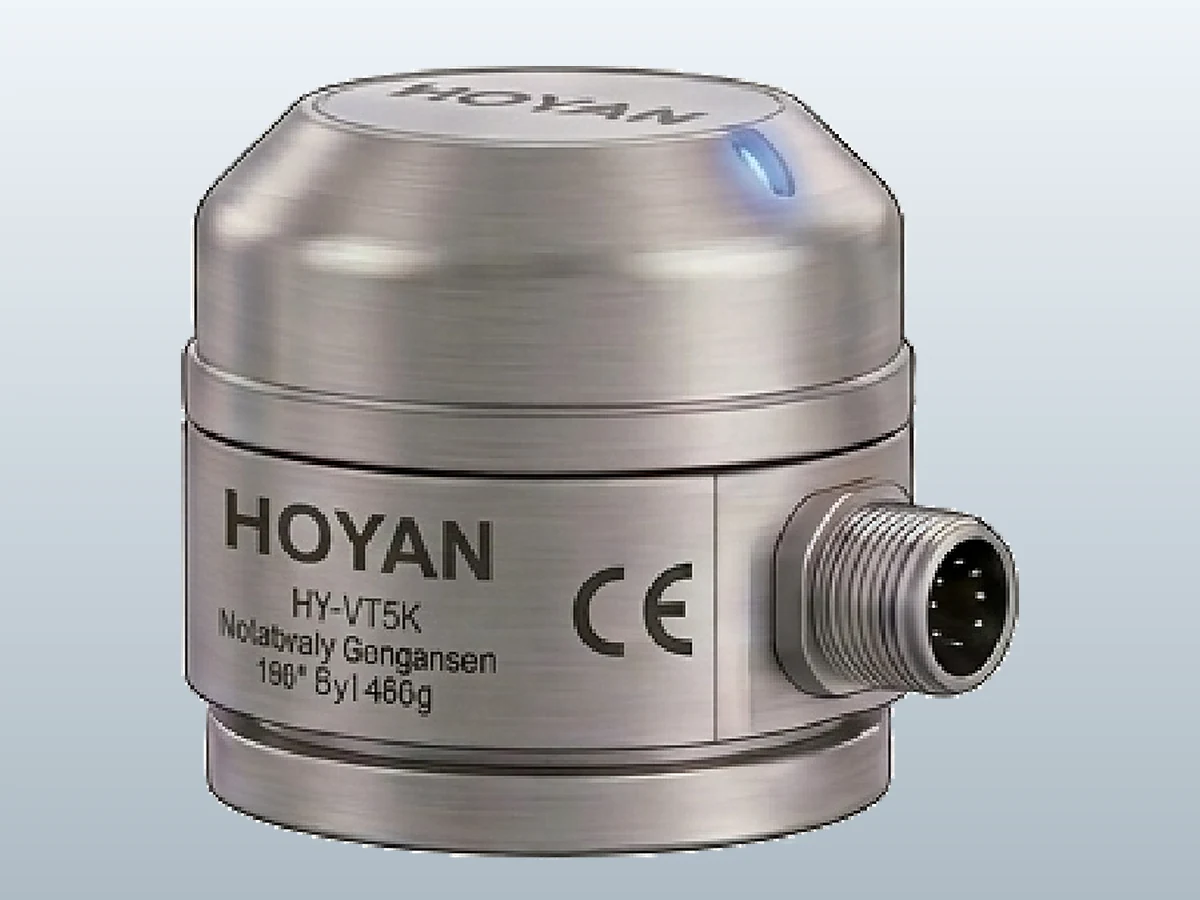
HY-VT3K / HY-VT5K Triaxial Vibration & Temperature Sensors

Contact-mounted triaxial vibration and temperature sensors designed for condition-based maintenance of rotating machinery. A 32-bit floating-point DSP performs FFT, velocity integration and statistical feature computation inside the sensor, delivering ready-to-interpret diagnostic data over Modbus RTU with no external acquisition unit.

HY-VT3K / HY-VT5K Triaxial Vibration & Temperature Smart Sensors

Sensor specifications

Amplitude-accurate bandwidth
VT3K 0.5 Hz – 3 kHz · VT5K 0.5 Hz – 5 kHz
Acceleration range
±4 / ±8 / ±16 g · ±15 / ±30 / ±60 g
FFT spectrum
6144 / 10240 lines · Δf 0.488 Hz
ISO verdict
Zone A / B / C / D output on board
Comms / protection
RS-485 Modbus RTU · 316 stainless steel / IP67

Three details that decide whether a reading can be trusted

A frequency axis you can trust

The sampling timebase is derived from a crystal oscillator, giving better than ±0.01% frequency-axis accuracy. Bearing fault frequencies (BPFO / BPFI) and gear mesh frequencies stay readable without timebase drift — a beautiful spectrum means nothing if the horizontal axis is off.

Data integrity first

If the sensing chain overloads, a sticky overload flag is set and the affected feature set is marked invalid. Clipped data never reaches the trend database — better one reading fewer than one reading wrong.

Identical bandwidth on every axis

All three axes, including Z, share the same amplitude-accurate bandwidth and noise specification, so mounting orientation does not limit measurement capability or force awkward installation angles.

Computed in the sensor, delivered as results

Triaxial synchronous sampling. FFT, velocity integration and statistical features are all computed inside the sensor and output directly over Modbus RTU.

Velocity and displacement
Velocity RMS and peak over 10 – 1000 Hz (the ISO 10816-3 / ISO 20816 evaluation band), with the upper limit configurable up to model bandwidth; displacement RMS and peak by frequency-domain integration over 2 – 1000 Hz.
FFT spectrum and time waveform
HY-VT3K covers 0 – 3 kHz with 6144 lines; HY-VT5K covers 0 – 5 kHz with 10240 lines. Both resolve at Δf 0.488 Hz, separating 1× and 2× components at low shaft speeds.
Statistical features and orders
Crest factor, kurtosis, skewness and standard deviation; dominant frequency detection with 1×, 2× and 3× shaft-order tracking (shaft speed written via a Modbus register).
ISO zone verdict
ISO 10816-3 Group 1–4 is selectable and the sensor outputs zone A / B / C / D with an exceedance flag directly — no conversion needed upstream.
Machine surface temperature
A contact NTC thermally coupled to the mounting face measures machine surface temperature rather than die temperature: −20 to +70 °C, ±1 °C.
Mounting health self-check
Surface and die temperature are compared continuously; abnormal differential drift indicates a loose sensor or degraded thermal coupling, warning before the measured data becomes distorted.

The mounting method sets the usable bandwidth

The high-frequency response of a contact vibration sensor is determined by the mounting interface — a physical limit, not a datasheet technicality. Guaranteed usable bandwidth is stated for each method, so factor in what fixing the site actually allows when selecting a model.

M8 stud mount (standard)
3 kHz full bandwidth on HY-VT3K, 5 kHz full bandwidth on HY-VT5K. Recommended for permanent installations.
Adhesive (thin cyanoacrylate layer)
3 kHz on HY-VT3K, approximately 3 kHz on HY-VT5K. Suitable for housings where drilling and tapping is not practical.
Magnetic base (VT-MAG accessory)
Approximately 1.5 kHz on both models. Suited to temporary points and route-based measurement rather than permanent monitoring.

Choosing between VT2000, VT3K and VT5K

All three connect over RS-485 Modbus RTU and can be mixed on the same gateway; select by the depth of diagnosis required. HY-VT2000 offers dual temperature channels and IP68 and suits high-count deployment where overall-level trending is enough, but it does not provide an ISO zone verdict — its 550 Hz Z-axis bandwidth does not cover the 10 – 1000 Hz evaluation band. For critical machines needing an ISO verdict or spectral diagnosis, choose HY-VT3K, whose noise density is down to 20 µg/√Hz for low-speed machines and structural monitoring, or HY-VT5K, whose ±60 g clipping-free range is the standard choice for CBM spectral diagnostics.

Motors & pumps Fans & blowers Gearboxes Low-speed mixers & rotating equipment Marine auxiliaries Cooling systems Machine-tool spindles Structural health monitoring

Need help planning sensor placement?

Tell us the machine types, speed range and the fixing method available on site, and we will recommend models, mounting methods and how many sensors to put on each gateway.

Contact us Back to products