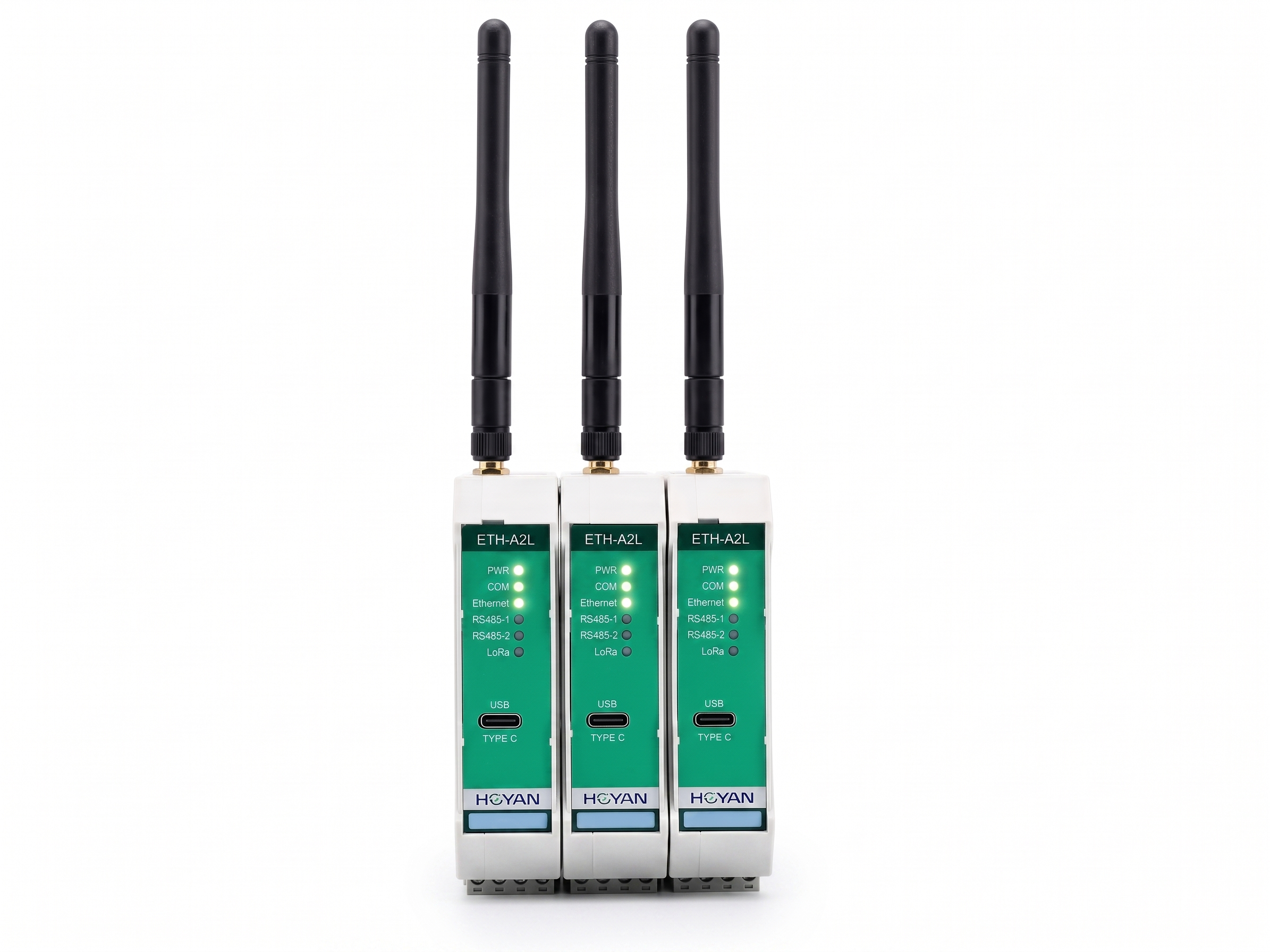
Gateway specifications
When cabling costs more than the equipment
Machines and pump stations spread across floors and buildings are usually not impossible to monitor — it is that one signal cable means opening a ceiling and shutting the line down. In a complex plant layout, the cabling work and the shutdown often cost several times the hardware.
No cable to pull
For points across a building, a deck or a road, a licence-free radio link removes the cabling cost entirely and with it the shutdown it would have required.
Rate and power are adjustable
Seven data rates and four power levels. Trade rate for distance on long links, or raise the rate for a faster update where points are close — the same unit adapts to different site conditions.
Compatible with the wired unit
Tag definitions and data formats match the ETH-A2E, so a mixed wired and wireless deployment presents one data model to the host system rather than two parsers to maintain.
One master, up to eight remote stations
The master runs the polling schedule and the remote stations acquire and answer. Scheduling is automatic and strictly request-and-reply, so collisions and retries need no handling of your own. Where terrain blocks the path or distance exceeds a single hop, a repeater in between extends coverage.
Kilometre range, four roles
Combined to suit the site
The same hardware takes any of four roles, combined according to distance and obstruction in the actual deployment.
Every reading carries a status flag
Tags are managed centrally and every reading carries a status flag. A wireless link is intermittent by nature, and the point of the status flag is that the host can tell "the value is zero" from "this reading never arrived" — a communication timeout is never misread as a measurement dropping to zero. I/O expansion shares the A2 module family, so a remote point needing extra I/O does not need a different module.
The same platform as ETH-A2E and ETH-A2N
The ETH-A2 series has three members: ETH-A2E for wired Ethernet, ETH-A2L over LoRa, and ETH-A2N for dual-LAN serial distribution. All three share the same A2 series I/O expansion modules and the same web configuration, so choosing by site condition does not mean three sets of spares and three sets of training. Wired runs on A2E and the points cable cannot reach run on A2L — a common combination.
Scattered points online without cabling
Before, signals between buildings needed cable and a shutdown to install, and remote or unmanned sites simply went unmonitored. After, scattered points are bridged over LoRa: logged continuously at second resolution and replayable, with thresholds raising alarms and push notifications automatically, and no existing control program modified. Nothing replaced and nothing rewritten keeps the cost of adoption manageable.
External antenna, positioned to suit the site
An external antenna lets you choose the type and placement to match the obstructions and mounting position on site, rather than being fixed by the orientation of an internal antenna. Inside a metal cabinet the antenna normally has to be brought outside the enclosure, which is worth factoring in when assessing range.
Want to check whether your distance and obstructions will work?
Tell us the distance between ends, what is in the way and the update rate you need, and we will assess the data rate setting and whether a repeater is required.